What if you could ask for what you want directly — with confidence, and without the fear of rejection?
Most of us learned to talk ourselves out of wanting things. Speaking of Desire is a short, deep practice for telling a true yearning from a passing itch so that you know how to ask for the right thing.

01
Desire is the sensation that keeps us moving forward
I was in my thirties, with a house and children and a fairly complicated life, but when the workshop leader asked me what I wanted, I was stumped. I’d learned to ask myself, “Do I need that, or do I just want it?” — and to quietly dismiss the wanting.
This was a mistake.
I’d become so good at deferred gratification, I forgot that “deferred” wasn’t supposed to be “forever.”
The goal of billions of years of evolution isn’t for conscious, social beings to live at a subsistence level and talk themselves into being content with it.
At its core, desire is a natural pull from the body asking for attention — it is how our nervous systems regulate themselves, find food, get adequate rest, make social connections, and search for meaning.
But — and this matters — it can also lead us astray.

We can get caught in habits and chase things for the wrong reasons. Our media and food environments encourage us to flood our bodies with temporary chemicals that mask uncomfortable truths.
And lots of the things we think we want are fundamentally about the ego and proving things.
It’s challenging to tease these sensations apart. It’s not impossible, but it does take time and energy.
Rather than teaching us the subtle embodiment skills that help distinguish healthy self-regulation from the ways it can go wrong, our culture gives us blanket warnings.
We are told not to trust ourselves. We must learn to avoid desire, and to be satisfied with what we have. We learn to second-guess, to downplay our wants (and even our needs), and we lose touch with the inborn capacity to feel our way towards fulfillment.
Desire is the path not to dissolution, but to genuine flourishing — if we can learn to harness it.
What if you could tell the difference, deep in your body, between a yearning that should be heeded and an itch asking to be scratched? If you could trust that intuition — what might become possible?
02
Claiming your desire is claiming your power
With the tools in Speaking of Desire, there’s no need to hedge your bets or water down your goals. With a few simple practices, you can name precisely what you want and find the courage to ask for it.
I’ll admit it: It took me years to figure this out.
I kept getting those permission slips from the universe - from my friends, from the self-help books (So-o-o-o-o many self-help books!) – and from things being much easier when I was honest with myself and the people around me… but I still had that sneaky voice at the back of my head saying, “You’re being greeeedy.”
I woke up one morning with this whole workshop fully formed in my head. I taught it the next day (I was already on retreat) and it rolled out as if I’d been running it for years.
And what I found is that it works — across a surprising range of questions.
One participant came up afterward and said, “Wow. I really don’t want to have children. I’ve only been pretending, to make my mother happy. Now I’ve got the words to go tell her.”
We won’t start with your hardest conversation with the most challenging person.

We start slowly — a glass of water on a hot day — a clear, obviously beneficial desire, before working up to the bigger questions.
A sequence of contemplations to come into right relationship with wanting
Calibrate the sensations of different kinds of desire in your body, so you can feel the difference rather than guess at it.
Clarify what you actually want — unpack the layers, and get precise about why you want a particular thing.
Ask — build the courage to request what you really want, even when you don’t yet know the answer, and work with the discomfort of hearing “no” (and the surprise of fearing “yes”).
03
How do I know if this is for me?
This version of the program is self-paced. It’s designed to be done in a single afternoon, but I can imagine sitting with the components for a few days and letting them integrate before moving on.
It works particularly well for people who are yearning to expand into something more exciting.
It helps when you know that you want something more, bigger, and juicier - but you’re not sure what.
- Your life is basically OK — you’ve got some ducks. Not in a row, but there are definitely ducks. And you sense there’s something more, bigger, juicier available.
- You have people who’d gladly support you more — if only you were willing to accept it.
- You’re relatively well-resourced and find yourself blocking support, rather than just barely holding on.
- You’re in the middle of chaos or turmoil. Settle your nervous system first — gently approaching desire while trapped or stuck can stir up a lot.
- You’re hoping this will be a one-step fix for loneliness or social isolation.
- You want to learn to trick people into giving you what you want. This is about clarity between ego and heart — any “player” approach isn’t my scene.
Like all meditation practice, this can surface things. I'm not present to help you regulate or debrief — if you're struggling with bigger things, please work with a well-established therapist instead.
04
The details
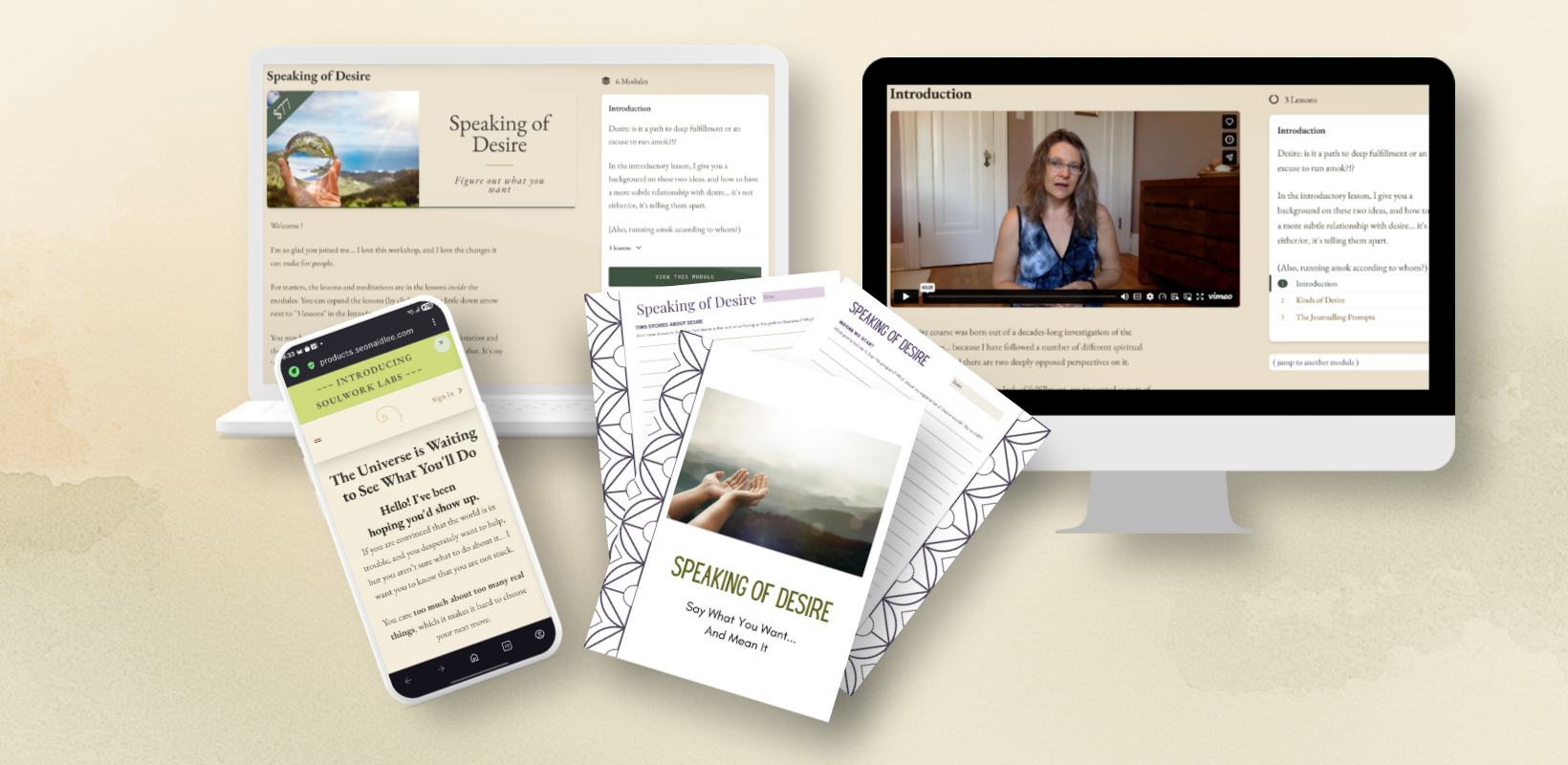
What's in the box
The workshop is broken into separate guided meditations, each with prompts to help you process what you find. Watch them in a single afternoon, or return to them over time as the practices integrate. Access lasts as long as I offer it — including any upgrades.
- Learning to Trust Desire
- Sensing Different Textures
- Untangling the Threads
- Summoning the Courage to Ask for What You Want
- Bonus module — The Weight of Other People’s Expectations.
- Bonus module — Maslow, Manifestation, and the Draw to Wholeness (free to preview, if you’d like a feel for the teaching first).
- A 16-page journal with prompts to deepen your contemplation at every stage.
“That was far deeper than I expected from a workshop this short. I came out knowing something I'd been pretending not to know for years — and with the words to finally say it.”
Is this live or self-paced?+
Entirely self-paced. It's designed to be done in a single afternoon, though many people prefer to sit with each component for a few days and let it integrate before moving on.
How long do I have access?+
For as long as I continue to offer the workshop — including any upgrades I add later, like audio-only versions of the meditations and transcripts.
Do I have to start with my big life questions?+
No — please don't. We start small and unambiguous, like a glass of water on a hot day, and build up. The practice works on everything from everyday wants to the questions you've been avoiding for years.
Can I preview the teaching before I buy?+
Yes. The bonus module Maslow, Manifestation, and the Draw to Wholeness is available to preview for free, no signup required, so you can get a feel for the tone.
Get started today
This is one of my very favourite projects. I hope it helps you toward a more, better, juicier life — one that delivers what you actually want.